Course
Arabic With Mufti Saim
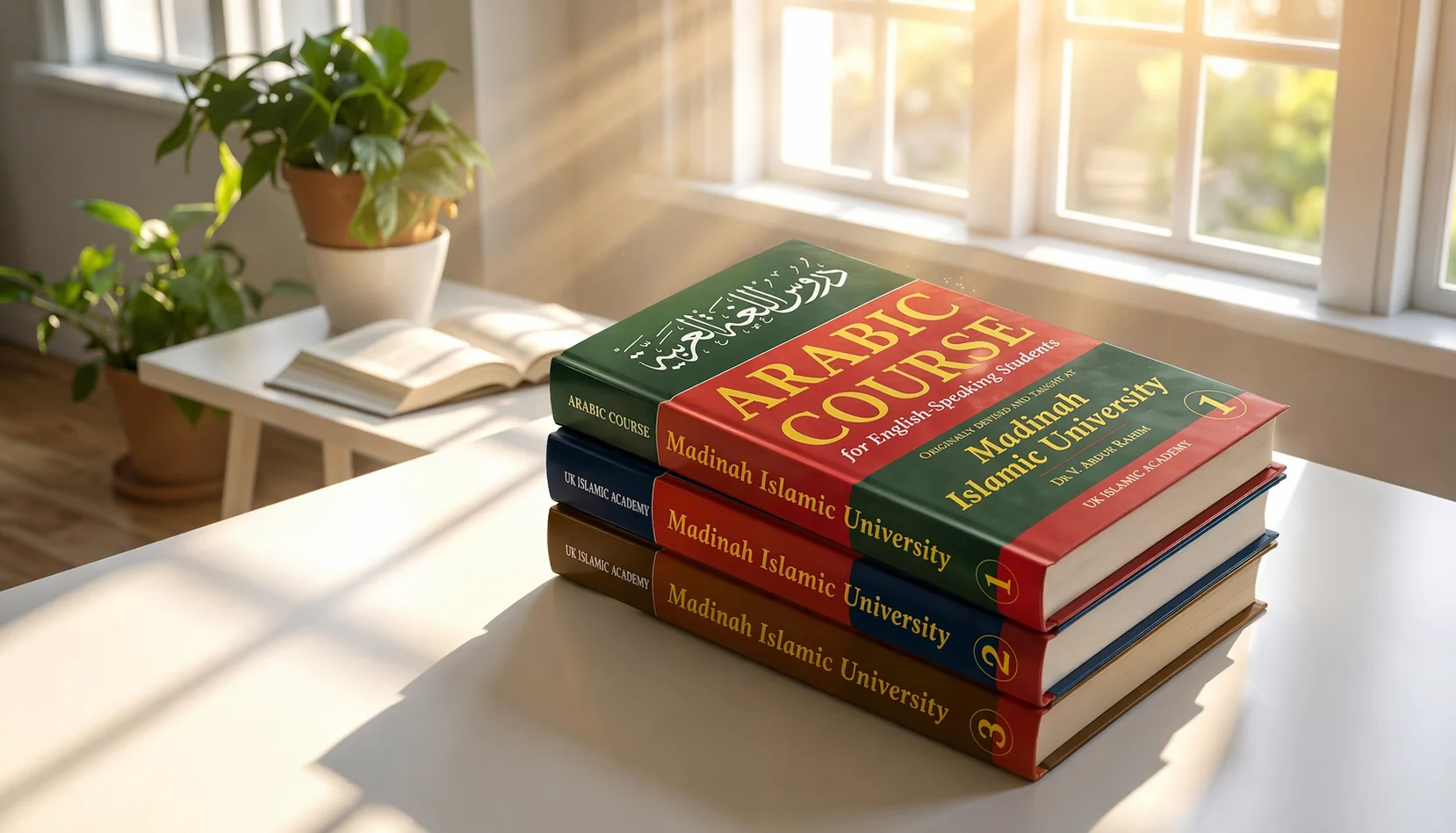
A structured introduction to classical Arabic using the Medina Series, taught by Mufti Saim at Masjid Hamza.
Schedule
Monday & Wednesday
After Maghrib
Lectures
67 lecturesBook 2
28 lecturesPresent & Past Tense Semantics: Time Expressions, Agent/Place Patterns, and Dual Agreement
Jun 15, 2026The session examined contextual semantics of past and present tense verbs, specifically how words like كُلَّ يَوْمٍ dictate habitual versus immediate meanings. It covered Arabic time-telling conventions using ordinals and fractions, the morphological مَفْعَل pattern for places/times of action and the فاعِل pattern (اسْمُ الْفَاعِل) for agents, dual subject-verb agreement rules based on word order, grammatical correction exercises involving frequency adverbs like أَحْيَانًا, and the technical status of أَمْس as a مَبْنِي word retaining a kasra despite technically being منصوب.
Identifying the Three Vowel Patterns of the مُضَارِع (Present Tense) Verb
Jun 15, 2026This session focused on identifying the middle vowel patterns for Arabic present tense (مُضَارِع) verbs. The instructor established that past tense verbs with a كَسْرَة reliably take a فَتْحَة in their present form, whereas those with a فَتْحَة are unpredictable and often require memorization or Quranic exposure. Key concepts included using الكَانَة (كَانَ) to indicate habitual past actions, the passive مَجْهُول pattern example يُقْتَلُ، and derivational vocabulary patterns like مَجْلِسٌ. The lesson concluded with a homework assignment to find three examples of each vowel type from the Quran, avoiding class-examined verbs.
Muḍāriʻ Verbs in the Quran, Ẓurūf (Adverbs of Time/Place), and the Pattern of Ism al-Ẓarf
May 18, 2026The session began with students sharing homework sentences using previously learned vocabulary and Quranic examples of مُضَارِع (muḍāriʻ) verbs, with the teacher providing corrections and contextual explanations. The class then continued reading a textbook passage (page 69) about a man's daily routine, through which the teacher introduced and reinforced several ظُرُوف (ẓurūf — adverbs of time and place), including دَائِمًا، أَحْيَانًا، مَرَّةً أُخْرَى، and مُتَأَخِّرًا. The teacher also explained the grammatical pattern of اسم الظرف (ism al-ẓarf), showing how verb roots produce words indicating a place or time of action, with examples such as مَصْنَع، مَكْتَب، مَدْرَسَة، and مَسْجِد.
الأسماء الموصولة والمقدمة في الأفعال المضارعة ومنهجية الممارسة
May 13, 2026The session reviews the system of relative pronouns (الأسماء الموصولة) used to describe nouns with descriptive clauses rather than a single صِفَة (ṣifah : adjective), covering forms for مُفْرَد (mufrad : singular), مُثَنَّى (muthannā : dual), and جَمْع (jam' : plural) across مُذَكَّر (mudhakkar : masculine) and مُؤَنَّث (mu'annath : feminine) forms. It examines Quranic usage and tafsir to show how grammatical number and gender clarify meaning and scholarly opinions. It then introduces present tense verbs (المُضَارِع), explaining how context determines whether they indicate current actions, future events, or habitual routines. The teacher highlights identical verb forms that require contextual distinction, the mathematical structure of Arabic roots, and strongly emphasizes continuous writing and speaking to internalize grammar and invite correction.
Formation of Plurals and Use of Pronouns in Arabic Sentences
May 11, 2026The session focused on جَمْع مُؤَنَّث سَالِم (jamʿ mu'annath sālim : sound feminine plural), particularly nouns ending in ـَات, and how their grammatical endings change depending on sentence function. The teacher emphasized that these nouns may take a كَسْرَة (kasrah : short i-vowel) instead of the expected فَتْحَة (fatḥah : short a-vowel) when functioning as a مَفْعُول (mafʿūl : object) or after a preposition. The class also practiced adding هَمْزَة الِاسْتِفْهَام (hamzat al-istifhām : interrogative hamzah) to form questions, examined shortened interrogative expressions such as مِمَّ, بِمَ, لِمَ, and عَمَّ, and practiced converting singular sentences into plural forms using الأسماء الموصولة and proper verb agreement.
Understanding Arabic Grammar Rules for Numbers and Sentence Structure
May 6, 2026The session focuses on understanding Arabic grammar rules, particularly with numbers 11 to 20 and onwards, where a singular version is used, and between 3 to 10, where the plural form is used. It also covers the importance of correct sentence structure and the use of pronouns. The teacher emphasizes the difference in meaning that can arise from slight changes in sentence structure, such as the use of خَلَقَنا (Khalaqna) versus خَلَقَ اللهُ (Khalaqallahu).
Introduction to Fa'al Ta'ajub and Jamm'a Mu'annath Salim
May 6, 2026The session covered the concept of فَعَلَ تَعَجُّب (Fa'al Ta'ajub), which is used to express amazement, and جَمْعَ مُؤَنَّث (Jamm'a Mu'annath Salim), a category of feminine plural nouns. The teacher provided examples and explanations to help students understand these concepts and their applications in Arabic sentences.
Expressing Amazement and Sentence Structures
May 4, 2026The session focused on using the particle مَا (ma) to express amazement through specific sentence structures in Arabic. The teacher explained examples like مَا أَسْهَلَ هَذَا الْدُّرُس (ma ashall hatha al-durus) for 'how easy this lesson is.' Key terms included grammatical structures, plurals, and vocabulary from Quranic contexts.
Using Past Tense Verbs in Context: Differentiating Speaker and Subject
Apr 29, 2026This lesson focuses on using مَاضِي (māḍī : past tense) verbs in context, distinguishing the role of the مُتَكَلِّم (mutakallim : speaker/first person) from that of third-person subjects, and practising correct pronoun attachment to verbs.
Understanding مُضَاف (mudāf : first term) and مُضَاف إِلَيْه (mudāf ilayh : second term) in Sentences
Apr 22, 2026The session covers the rules of مُضَاف (mudāf : first term of a genitive construct) and مُضَاف إِلَيْه (mudāf ilayh : second term), focusing on how the مَعْرِفَة (ma'rifah : definiteness) or نَكِرَة (nakirah : indefiniteness) of the مُضَاف depends on the مُضَاف إِلَيْه. Examples like ذُو غِلَافٍ أَحْمَر (dhū ghilāfin aḥmar : the one with a red cover) illustrate when to use أَلْ based on context. The class also covers Arabic fractions.
Verbs, Questions, and Pronouns in Arabic: كَانَ (kāna : was/to be) and Interrogative Structures
Apr 20, 2026This lesson covers the verb كَانَ (kāna : was/to be) and its conjugation across مُذَكَّر (mudhakkar : masculine) and مُؤَنَّث (mu'annath : feminine) forms, alongside interrogative structures and pronoun usage in Arabic sentences.
Numbers 11-20 and Sentence Construction in Arabic
Apr 15, 2026This lesson covers Arabic numbers from 11 to 20, explaining the gender-agreement rule for مُذَكَّر (mudhakkar : masculine) and مُؤَنَّث (mu'annath : feminine) counted nouns, and introduces basic sentence construction with فَاعِل (fā'il : doer) and مَفْعُول (maf'ūl : object).
Introduction to Arabic Verbs: ذَهَبَ (dhahaba : to go) and كَانَ (kāna : to be)
Apr 13, 2026This lesson introduces key Arabic verbs, focusing on ذَهَبَ (dhahaba : to go) and كَانَ (kāna : to be), their conjugations across مُذَكَّر (mudhakkar : masculine) and مُؤَنَّث (mu'annath : feminine) forms, and their usage in sentences. Students practise past-tense patterns and explore how verb endings change according to person and gender.
Addressing Females: Verbs and Pronouns in تَمْرِين (tamrīn : exercise) Lesson 4
Apr 8, 2026This session covers verb conjugation when addressing مُؤَنَّث (mu'annath : feminine) subjects, including كَتَبَ (kataba : he wrote), ذَهَبَتْ (dhahabat : she went), and related forms. Students practise using أَخَوَاتِي (akhawātī : my sisters) vs. إِخْوَتِي (ikhwatī : my brothers) and responding with نَعَمْ (na'am : yes) and بَلَى (balā : yes [after a negative]).
Using لَيْسَ (laysa : is not) and Understanding مُبْتَدَأ (mubtada' : subject) Rules
Apr 6, 2026This lesson focuses on لَيْسَ (laysa : is not) for negation in nominal sentences, its effect on the مُبْتَدَأ (mubtada' : subject) and خَبَر (khabar : predicate), and the role of حَرْفُ الْجَرّ (ḥarf al-jarr : preposition) in sentence structure. Rules for مَعْرِفَة (ma'rifah : definite) and نَكِرَة (nakirah : indefinite) nouns are reinforced.
Basics of Arabic Verbs: Past Tense and Attached ضَمَائِر (ḍamā'ir : pronouns)
Apr 1, 2026This lesson covers past-tense verb conjugation with attached ضَمَائِر (ḍamā'ir : pronouns) functioning as مَفْعُول (maf'ūl : object), the صِيغَةُ الأَمْر (ṣīghat al-amr : imperative form), and the distinction between dual مُؤَنَّث (mu'annath : feminine) forms and جَمْع (jam' : plural) forms. Example: دَخَلْتَا (dakhaltā : the two of them [dual fem.] entered) is مُثَنَّى (muthannā : dual) مُؤَنَّث and must not be confused with the جَمْع (jam' : plural) دَخَلُوا (dakhalū : they [masc. pl.] entered).
Identifying فَاعِل (fā'il : doer) and مَفْعُول (maf'ūl : object) in Sentences: Verbs Requiring Objects
Mar 30, 2026This lesson focuses on distinguishing فَاعِل (fā'il : doer/agent of a verb) from مَفْعُول (maf'ūl : object) in verbal sentences. The فَاعِل takes a ضَمَّة (ḍammah : short u-vowel) and the مَفْعُول takes a فَتْحَة (fatḥah : short a-vowel). Students practise identifying these roles using مُتَعَدِّي (muta'addī : transitive) verbs that require a direct object.
Understanding مَفْعُول (maf'ūl : object) in Past Tense Verbs and Verb Patterns
Mar 25, 2026This session focuses on identifying the مَفْعُول (maf'ūl : object) in past-tense verbs, emphasising how objects receive a فَتْحَة (fatḥah : short a-vowel) while the فَاعِل (fā'il : doer/agent) carries a ضَمَّة (ḍammah : short u-vowel). The teacher distinguishes between فَاعِل and مَفْعُول, highlights exceptions, and discusses verb patterns فَعَلَ / فَعِلَ / فَعُلَ with examples from the Qur'an.
Advanced Practice with Past Tense Verbs and Negation
Feb 21, 2026This session provides advanced practice with past-tense verb conjugation, negation particles including مَا (mā : not [past tense]) and لَكِنَّ (lakinna : but/however), and the particle كَأَنَّ (ka'anna : as if). Emphasis is placed on correctly distinguishing مُذَكَّر (mudhakkar : masculine) and مُؤَنَّث (mu'annath : feminine) verb endings.
Arabic Numbers and Verb Negation: Demonstrative Questions and Family Terms
Feb 16, 2026This session covers Arabic numbers, verb negation patterns, demonstrative question structures such as أَلَيْسَ كَذَلِكَ؟ (alaysa kadhālik : is it not so?), and vocabulary related to family terms. Ordinal numbers such as الأَوَّل (al-awwal : the first) are also introduced.
Comparative Adjectives and Numbers in Arabic
Jan 28, 2026This session covers اِسْمُ التَّفْضِيل (ism al-tafḍīl : comparative adjective) forms such as أَحْسَن (aḥsan : better/best) and أَطْوَل (aṭwal : taller/tallest), their agreement rules for مُذَكَّر (mudhakkar : masculine) and مُؤَنَّث (mu'annath : feminine) nouns, and the use of particles like كَأَنَّ (ka'anna : as if) in sentences.
Numbers 11 to 20 and اِسْمُ التَّفْضِيل (ism al-tafḍīl : comparative noun): Rules and Applications
Jan 21, 2026This lesson covers the numbers 11–20 and introduces اِسْمُ التَّفْضِيل (ism al-tafḍīl : the comparative/superlative noun), built on the pattern أَفْعَل (af'al), used to express 'more/most' in Arabic. Rules for gender agreement and the use of مِن (min : than) in comparisons are also discussed.
Understanding the Uses of لَيْسَ (laysa : is not) and إِنَّ (inna : indeed) in Sentences
Jan 12, 2026The class reviewed key concepts from تَمْرِين (tamrīn : exercise) 8, focusing on the correct usage of لَيْسَ (laysa : is not) with different grammatical structures and the emphasis added by إِنَّ (inna : indeed). Students practised forming responses using the same words as questions and explored exceptions introduced by these particles.
Negation with لَيْسَ (laysa : is not) in the Qur'an and Sentence Structure
Jan 7, 2026This lesson examines how لَيْسَ (laysa : is not) is used for negation in Qur'anic Arabic, focusing on its conjugation for مُفْرَد (mufrad : singular) and جَمْع (jam' : plural) forms, مُذَكَّر (mudhakkar : masculine) and مُؤَنَّث (mu'annath : feminine), and its role in nominal sentence structure.
Counting with مِئَة (mi'ah : one hundred) and أَلْف (alf : one thousand)
Dec 15, 2025This session covers how to use مِئَة (mi'ah : one hundred) and أَلْف (alf : one thousand) in counting and in مُضَاف–مُضَاف إِلَيْه (mudāf–mudāf ilayh : possessive construct) structures, with practice on forming larger numbers in Arabic.
إِنَّ (inna : indeed) and its Effects on Sentence Structure, مُبْتَدَأ (mubtada' : subject) and خَبَر (khabar : predicate)
Dec 10, 2025This lesson focuses on the grammatical effects of using إِنَّ (inna : indeed) at the beginning of a sentence, particularly how it impacts the case endings (الحَرَكَات (ḥarakāt : vowel markings)) of subsequent nouns. Students learn that إِنَّ (inna : indeed) initiates a declaratory sentence structure where the مُبْتَدَأ (mubtada' : subject) takes a فَتْحَة (fatḥah : accusative marker), and the خَبَر (khabar : predicate) maintains its default case. The teacher provides examples with proper nouns and attributes, emphasizing when تَنْوِين (tanwīn : nunation) is applied versus using 'al'.
Homework Review on إِنَّ (inna), Question Structures, and Sentence Formation
Dec 8, 2025This session primarily reviewed homework from the previous lesson, reinforcing the use of إِنَّ and how it interacts with attached pronouns and sentence structure. The teacher corrected student responses, clarified how to answer comprehension questions, explained the distinction between asking about people versus objects using appropriate question words, and reviewed sentence patterns involving أَمْ for “or” questions. The lesson also introduced vocabulary related to marital status, including مُتَزَوِّج (mutazawwij : married man), مُتَزَوِّجَة (mutazawwijah : married woman), and زَوْج / زَوْجَة (zawj / zawjah : spouse), while reinforcing practical dialogue construction and grammatical accuracy.
Introduction to إِنَّ (inna : indeed/verily), لَعَلَّ (la‘alla : perhaps), and Related Grammar Concepts
Dec 3, 2025This session introduces إِنَّ (inna : indeed/verily), focusing on its grammatical role and usage for emphasis within sentences. The lesson explains how إِنَّ enters a جُمْلَة اِسْمِيَّة (jumlah ismiyyah : nominal sentence) and changes the original مُبْتَدَأ (mubtada' : subject) to take a فَتْحَة (fatḥah : short a-vowel), while the خَبَر (khabar : predicate) remains unchanged. Practical examples from the Qur'an illustrate its application. The lesson also introduces attached pronouns with إِنَّ, the related particle لَعَلَّ (la‘alla : perhaps), and additional grammar concepts such as أَمْ (am : or, in questions) and ذُو (dhū : possessor of).
Book 1
39 lecturesAnalyzing Sentences for إِعْرَاب (iʿrāb : case analysis) and Vocabulary
Nov 19, 2025The session focused on breaking down sentences for grammatical analysis, including identifying elements like اِسْمُ الْإِشَارَةِ (ism al-ishārah : demonstrative nouns), attached pronouns (e.g., يَا 'ya' : my), gender consistency in plurals, and special cases such as non-sentient plurals treated as feminine singular. Key vocabulary included school terms and family names. The session emphasized applying rules like غَيْرُ الْمُنْصَرِف (ghayr al-munsarif : non-declinable) nouns during sentence deconstruction.
Arabic Nouns: Plurals, Dual Forms, and Gender Agreement in Numbers
Nov 17, 2025The session reviewed key grammatical concepts including plurals of non-intellect beings (غَيْرُ عَاقِل : ghayr al-ʿāqil) treated as singular feminine, dual forms using the suffix انِ (āni), and rules for gender agreement when counting objects. The teacher emphasized foundational topics for an upcoming test, focusing on practical examples and clarifying common confusion points.
Arabic Lesson 8-13 Review: Key Concepts in Grammar, Plurals, and Pronouns
Nov 12, 2025This session reviews lessons 8 to 13, focusing on grammatical structures like the مَوْصُوف (mawṣūf : described noun) and صِفَة (ṣifah : adjective/descriptor) agreement, ظَرْف (ẓarf : adverb of time/place) usage (e.g., أَمَام : amāma : in front of), attached pronouns, plurals (qiyasi and sama'i), and verb forms. Important concepts include noun-adjective agreement rules, relative pronouns (الذي), and negation with مَا.
Proper Nouns in Harakah Rules: Non-Arabic Names and Exceptions
Nov 5, 2025The session focuses on applying ḥarakah rules to proper nouns, particularly non-Arabic names. The teacher explains exceptions where words do not follow the standard kasrah rule due to being غَيْرُ الْمُنْصَرِف (ghayr al-munsarif : non-declinable), emphasizing examples like مَسَاجِدُ (masājid : mosques), وَاشِنْطُن (Wāshintun : Washington), and لَنْدَن (Landan : London).
غَيْرُ الْمُنْصَرِف (ghayr al-munsarif : non-declinable) Nouns and Proper Nouns in Arabic
Nov 3, 2025This session focuses on non-declinable nouns (غَيْرُ الْمُنْصَرِف : ghayr al-munsarif) that do not take tanween or kasrah under specific conditions. The teacher explains various categories of such nouns, including female proper names, certain patterns like فَعْلَان (faʿlān) and أَفْعَل (afʿal), and non-Arabic proper nouns. Examples include names like عَائِشَة (ʿĀʾishah), أُسَامَة (Usāmah), and لندن (London).
غَيْرُ الْمُنْصَرِف (ghayr al-munsarif : non-declinable) Nouns: Rules and Applications in Arabic Grammar
Oct 29, 2025The session focused on the grammatical rule of غَيْرُ الْمُنْصَرِف (ghayr al-munsarif : non-declinable) — nouns and adjectives that do not take كَسْرَة (kasrah) or تَنْوِين (tanwīn). The teacher explained how these words take فَتْحَة (fatḥah) wherever كَسْرَة would normally appear. Examples included colors and proper nouns like أَمِينَةُ (Aminatu), which are non-declinable. Homework involved reading Lesson 22's English section to reinforce understanding.
Nouns, Plurals, and Demonstratives: Non-Sentient Plural Agreement and Case Endings
Oct 27, 2025The session reviewed homework related to describing a classroom using proper Arabic nouns and grammatical structures. Key focus was placed on recognizing plural forms of non-sentient objects (غَيْرُ الْعَاقِل : ghayr al-ʿāqil : non-sentient), correct case endings, and contextual usage of demonstrative pronouns. Students practiced translating sentences about the classroom setup while correcting common errors in gender agreement and مَوْصُوف-صِفَة (mawṣūf-ṣifah : noun-adjective) concordance.
Using Numbers with Nouns: Gender and Plural Agreement in Arabic
Oct 22, 2025The session focuses on correctly applying numbers to nouns in Modern Standard Arabic, emphasizing gender agreement and plural forms. The teacher explains how numeric adjectives must agree in gender with the noun they modify and how plurals affect this agreement. Students practice translating sentences using correct grammatical structures.
Numbers in Arabic Grammar: Masculine-Feminine Opposites and Practical Application
Oct 20, 2025The session focused on applying masculine-feminine number rules to female nouns. Students practiced forming numbers from three to ten with feminine مَعْدُود (maʿdūd : counted noun), emphasizing the opposite gender rule for numbers. The teacher used examples like 'four students' (أَرْبَعُ طَالِبَاتٍ : arbaʿu ṭālibāt) and discussed pluralization in specific contexts, clarifying common mistakes regarding تَنْوِين (tanwīn) and مُضَاف-مُضَافٌ إِلَيْهِ (muḍāf-muḍāf ilayhi) rules.
Pronouns, Verbs and Context Clues in Arabic
Sep 17, 2025This lesson covers the correct use of pronouns in response to context clues, specifically focusing on gender and number agreement for address terms. It also emphasizes understanding time-related adverbs like قَبْلَ (qabla : before) and بَعْدَ (baʿda : after), and how they attach to nouns. The teacher underscores the importance of context in determining verb forms and possessive structures.
Understanding the Object of a Verb (المفعول به) in Arabic
Apr 21, 2025The session focused on explaining the concept of the object of a verb (المفعول به) in Modern Standard Arabic, emphasizing its grammatical rules and practical applications. The teacher used Quranic examples to illustrate how the presence of a فَتْحَة (fatḥah : short a-vowel) indicates an object and stressed avoiding common mistakes that alter meanings.
Pronouns and Present Tense in the Qur'an: Examples from Surahs and Grammar Rules
Apr 16, 2025The session focused on understanding Arabic pronouns الضَّمَائِر (ḍamāʾir : pronouns) through examples from the Qur'an, emphasizing how they connect to different nouns based on جِنْس (jins : gender). The teacher also introduced present tense verbs like أُحِبُّ (uḥibbu : I love), highlighting how objects receive فَتْحَة (fatḥah : short a-vowel) cases. Students reviewed grammar rules and applied them to translations of Qur'anic verses.
Lesson on Possessive Pronouns and Interrogative Structures in Arabic
Apr 14, 2025This lesson focuses on interrogative structures and possessive pronouns in Modern Standard Arabic, emphasizing correct usage through examples involving family members, objects, and daily conversations. The teacher explains when to use لِ (li : for/belonging to), عِنْدَ (ʿinda : possession/proximity particle), and other particles for possession, as well as translating questions like 'Do you have...?' and their answers.
Understanding مَا (mā : particle) in Arabic: Interrogative and Negative Uses
Apr 9, 2025This session focuses on distinguishing between the interrogative (مَا الِاسْتِفْهَامِيَّة (mā al-istifhāmiyyah : interrogative mā)) and negative uses of مَا النَّافِيَة (mā al-nāfiyah : negative mā). Students learn to identify مَا based on context, contrasting it with لَا (lā : negation particle) for negation. The teacher emphasizes applying these concepts through examples from daily conversations and the Qurʾān.
Arabic Pronouns and Their Attached Forms: هُوَ (huwa), هِيَ (hiya), ـكَ (ka), and ـي (yā)
Apr 7, 2025This session teaches detached and attached pronouns in Modern Standard Arabic, focusing on their usage to replace repeated nouns. The teacher explains how attached pronouns like ـكَ (ka : your) and ـي (yā : my) modify nouns, emphasizing examples and avoiding overcomplication with advanced grammar.
Understanding Relative Clauses with اَلَّذِي (alladhī : who/that) and Descriptions in Arabic
Feb 24, 2025This session focuses on the use of relative clauses (اَلَّذِي — alladhī : who/that) and descriptive phrases in Modern Standard Arabic. Key points include understanding how to construct sentences with اَلَّذِي (alladhī), differentiating between definite and indefinite nouns in descriptives, and proper verb conjugation for past tense verbs like ذَهَبَ (dhahaba : he went). The teacher emphasizes recognizing grammatical structures through examples and avoids situational rules.
غَيْرُ الْمُنْصَرِف (ghayr al-munṣarif : diptote), اِسْم الْمَوْصُول (ism al-mawṣūl : relative pronoun), and Related Grammar Concepts
Feb 19, 2025This session covers the Arabic grammatical concept of غَيْرُ الْمُنْصَرِف (ghayr al-munṣarif : diptote — words that do not take tanwīn or kasrah), distinguishing it through examples from the Qurʾān and classical texts. The teacher explains exceptions like أَسْمَاء الْمُؤَنَّث (asmāʾ al-muʾannath : feminine names) and specific noun patterns, then transitions to discuss اِسْم الْمَوْصُول (ism al-mawṣūl : relative pronoun) with examples from the Qurʾān, focusing on usage rules and pronunciation adjustments including اِلْتِقَاءُ السَّاكِنَيْنِ (iltiqāʾ al-sākinayn : meeting of two sukūns) for smooth recitation.
Advanced Practice with مَوْصُوف (mawṣūf : described noun) and صِفَة (ṣifah : adjective) in the الْقُرْآن (al-Qurʾān : Qur'an)
Feb 12, 2025This session focuses on deepening understanding of مَوْصُوف (mawṣūf : described noun) and صِفَة (ṣifah : adjective) through examples from the الْقُرْآن (al-Qurʾān : Qur'an). The teacher emphasizes applying four criteria: gender (مُذَكَّر (mudhakkar : masculine) / مُؤَنَّث (mu'annath : feminine)), number (مُفْرَد (mufrad : singular) / مُثَنَّى (muthannā : dual) / جَمْع (jam' : plural)), final حَرَكَة (ḥarakah : vowel mark), and definiteness/indefiniteness (مَعْرِفَة (maʿrifah : definite) / نَكِرَة (nakirah : indefinite)). Students are encouraged to identify these structures in Qur'anic verses, with ample examples provided.
مَوْصُوف (mawṣūf : described noun) and صِفَة (ṣifah : adjective): Matching Adjectives and Nouns in Arabic
Feb 10, 2025This session explains how nouns (مَوْصُوف (mawṣūf : described noun)) and adjectives (صِفَة (ṣifah : adjective)) must agree in Arabic grammar. The agreement rules cover four main areas: gender (جِنْس (jins : gender)), number (عَدَد (ʿadad : number)), case ending (إِعْرَاب (iʿrāb : case ending)), and definiteness (مَعْرِفَة (maʿrifah : definite) / نَكِرَة (nakirah : indefinite)). The lesson uses Quranic and classroom examples to demonstrate how adjectives must match the nouns they describe in all these grammatical features.
مَوْصُوف (mawṣūf : described noun) and صِفَة (ṣifah : adjective): Adjectives and Descriptions in Classical Arabic
Feb 5, 2025Session focuses on the grammatical structure of adjectives (صِفَة (ṣifah : adjective)) and their described nouns (مَوْصُوف (mawṣūf : described noun)) in Modern Standard Arabic. The teacher emphasizes that adjectives follow the noun they describe, unlike English. Key examples include اِمْرَأَةٌ حَسَنَةٌ (imraʾah ḥasanah : good woman) and terms from religious texts. Students practice constructing sentences with proper case endings (حَرَكَات (ḥarakāt : vowel marks)) and gender agreement.
Introduction to Arabic Demonstrative Adjectives and Belonging Structures
Jan 29, 2025The session focuses on using demonstrative adjectives (هٰذَا, تِلْكَ) with nouns to specify possession and origin in Arabic. The teacher emphasizes structures like هٰذَا الْبَيْتُ لِـ for indicating ownership and answers student questions about exceptions in European country names.
Reviewing Sentence Structures and Vocabulary
Jan 27, 2025The session focuses on reviewing sentence structures, vocabulary, and grammar rules from the eighth lesson (الدَّرْسُ الثَّامِن (ad-dars al-thāmin : the eighth lesson)). Students practice creating sentences using new terms like 'merchant', 'doctor', and prepositions such as أَمَامَ (amāma : in front of) and خَلْفَ (khalfa : behind). The teacher emphasizes correct sentence formulation in Arabic, distinguishing it from English word order, and explains the use of the definite article (اَلْـ / alif-lām : definite article) with demonstratives.
Test Review Session on مَضَاف وَمُضَاف إِلَيْهِ (muḍāf wa muḍāf ilayh : genitive construction) and Core Grammar Rules
Jan 13, 2025This session reviews upcoming test material focusing on مَضَاف وَمُضَاف إِلَيْهِ (muḍāf wa muḍāf ilayh : genitive construction), grammatical case system (إِعْرَاب), and correct application of ḥarakāt. The teacher emphasizes applying rules in practice, especially iḍāfa structure, case endings, gender agreement, and noun classification (ism, fiʿl, ḥarf). Students are encouraged to focus on understanding and applying core grammar rules rather than memorization.
Arabic Grammar: حُرُوف الْجَرّ (ḥurūf al-jarr : prepositions), مُضَاف (muḍāf : possessed noun) and مُضَافٌ إِلَيْهِ (muḍāf ilayhi : possessor), Verbs in فِعْل مَاضِي (fiʿl māḍī : past tense)
Dec 18, 2024The session covered advanced grammar topics including the functions and usage of حُرُوف الْجَرّ (ḥurūf al-jarr : prepositions — making following words مَجْرُور — majrūr : genitive), rules governing مُضَاف (muḍāf : possessed noun) and مُضَافٌ إِلَيْهِ (muḍāf ilayhi : possessor), and فِعْل مَاضِي (fiʿl māḍī : past tense) verbs indicating مُذَكَّر (mudhakkar : masculine), مُفْرَد (mufrad : singular), third person. Key examples included فِي (fī : in), عَلَى (ʿalā : on) as prepositions and verbs like خَرَجَ (kharaja : he exited) for actions in the past.
Understanding جِنْس (jins : gender) in Nouns and Body Parts with Examples from the Qurʾān
Dec 11, 2024This session focuses on determining جِنْس (jins : gender) of Arabic nouns, particularly for body parts and nouns lacking تَاء مَرْبُوطَة (tāʾ marbūṭah : the feminine marker ة). The teacher covers لَامُ الْجَرّ (lāmu l-jarr : the preposition lam — لِـ), which assigns كَسْرَة (kasrah), and distinguishes between سَمَاعِي (samāʿī : heard/memorized) gender rules and those predictable from word endings.
Arabic Handwriting Practice and جِنْس (jins : gender) Identification in Nouns
Dec 9, 2024This session focuses on Arabic handwriting practice and identifying the جِنْس (jins : gender) of nouns. The teacher distinguishes تَاء مَرْبُوطَة (tāʾ marbūṭah : the feminine marker ة) from تَنْوِين (tanwīn : the indefinite double vowel ending), clarifies which nouns are سَمَاعِي (samāʿī : heard/memorized) مُؤَنَّث (muʾannath : feminine) without تَاء مَرْبُوطَة, and reviews writing exercises from the textbook.
Understanding Possessive Constructions in Arabic: اِبْن (ibn : son) and كِتَابٌ (kitābun : a book)
Dec 2, 2024This session covers the مُضَاف (muḍāf : possessed noun) and مُضَافٌ إِلَيْهِ (muḍāf ilayhi : possessor) possessive construction with examples like اِبْنُ الْمُدَرِّسِ (ibnu l-mudarrisi : the son of the teacher). The teacher also explains حَمْزَةُ الْوَصْل (hamzat al-waṣl : connecting hamza) as it appears in اِبْن (ibn) and similar words, and reviews how the مُضَاف (muḍāf) loses its اَلْ and تَنْوِين (tanwīn).
Understanding مُضَاف (muḍāf : possessed noun) and مُضَافٌ إِلَيْهِ (muḍāf ilayhi : possessor) and Possessive Constructions in Arabic Grammar
Nov 25, 2024This session covers the مُضَاف (muḍāf : possessed noun) and مُضَافٌ إِلَيْهِ (muḍāf ilayhi : possessor) construction and how حَرْف الْجَرّ (ḥarf al-jarr : preposition) particles interact with possessive phrases. The teacher provides Qurʾānic examples and clarifies common mistakes in applying possessive rules.
Understanding مُضَاف (muḍāf : possessed noun) and مُضَافٌ إِلَيْهِ (muḍāf ilayhi : possessor) in Arabic Grammar
Nov 20, 2024This session focuses on the مُضَاف (muḍāf : possessed noun) and مُضَافٌ إِلَيْهِ (muḍāf ilayhi : possessor) possessive construction with Qurʾānic examples such as نَصْرُ اللَّهِ (naṣru llāhi : the help of Allah) and جَنَّاتُ عَدْنٍ (jannātu ʿadnin : gardens of Eden). Rules discussed include the مُضَاف losing its تَنْوِين (tanwīn) and اَلْ, and the مُضَافٌ إِلَيْهِ taking كَسْرَة (kasrah).
Possessive Constructions and Question-Answer Dynamics in Arabic
Nov 18, 2024This session covers the مُضَاف (muḍāf : possessed noun) and مُضَافٌ إِلَيْهِ (muḍāf ilayhi : possessor) possessive construction, translatable as 'the X of Y' (e.g., كِتَابُ مُحَمَّدٍ — kitābu muḥammadin : the book of Muḥammad). The teacher also covers حَرْف النِّدَاء (ḥarf al-nidāʾ : the vocative particle) يَا (yā : O), explains حَمْزَةُ الْوَصْل (hamzat al-waṣl : connecting hamza) and how اَلِف (alif) behaves in connected speech, and reviews question-answer patterns.
Arabic Writing and Pronunciation with Focus on Key Verbs and Particles
Nov 11, 2024This session focuses on Arabic handwriting practice and pronunciation of key vocabulary and particles. The teacher introduces past tense — فِعْل مَاضِي (fiʿl māḍī : past tense verb) — verbs such as خَرَجَ (kharaja : he exited) and reviews حُرُوف الْجَرّ (ḥurūf al-jarr : prepositions) like مِنْ (min : from). Students practiced writing and translating sentences, including how مَاضِي (māḍī : past tense) verbs indicate completed actions.
Introduction to Arabic حُرُوف الْجَرّ (ḥurūf al-jarr : letters of genitive) and Pronouns
Nov 6, 2024This session introduces حُرُوف الْجَرّ (ḥurūf al-jarr : letters of genitive) and their role in assigning كَسْرَة (kasrah) to the following noun, making it مَجْرُور (majrūr : genitive). The lesson covers attached pronouns (ضَمَائِر — ḍamāʾir : pronouns) for possession, discusses why أَسْمَاء الْمُؤَنَّث (asmāʾ al-muʾannath : feminine names) do not take تَنْوِين (tanwīn), and introduces حَمْزَةُ الْوَصْل (hamzat al-waṣl : connecting hamza).
Introduction to Definite Articles and حُرُوف الْجَرّ (ḥurūf al-jarr : letters of genitive)
Oct 30, 2024This lesson introduces the concept of حُرُوف الْجَرّ (ḥurūf al-jarr : letters of genitive), particles that assign a كَسْرَة (kasrah) to the following noun (making it مَجْرُور — majrūr : genitive). The five prepositions covered are فِي (fī : in), عَلَى (ʿalā : on), إِلَى (ilā : to), مِنْ (min : from), and لِـ (li- : for/belonging to). The lesson also reviews how اَلْ (al- : the definite article) and تَنْوِين (tanwīn) are mutually exclusive, introduces حَمْزَةُ الْوَصْل (hamzat al-waṣl : connecting hamza), and covers vocabulary for common objects.
اَلْمِنْدِيل (al-mindīl : handkerchief) and the Definite Article اَلْ in Arabic: اَلْحُرُوف الشَّمْسِيَّة (al-ḥurūf al-shamsiyyah : sun letters) vs اَلْحُرُوف الْقَمَرِيَّة (al-ḥurūf al-qamariyyah : moon letters)
Oct 28, 2024This session covers the Arabic definite article اَلْ (al- : the) and how its pronunciation changes depending on the first letter of the word it precedes. When preceding اَلْحُرُوف الشَّمْسِيَّة (al-ḥurūf al-shamsiyyah : sun letters), the lām of اَلْ is assimilated (e.g., اَلشَّمْسُ — ash-shamsu : the sun). When preceding اَلْحُرُوف الْقَمَرِيَّة (al-ḥurūf al-qamariyyah : moon letters), the lām is pronounced clearly (e.g., اَلْقَمَرُ — al-qamaru : the moon).
Identifying Definite and Indefinite Nouns Through Particle Usage
Oct 23, 2024This session focuses on distinguishing between مَعْرِفَة (maʿrifah : definite) and نَكِرَة (nakirah : indefinite) nouns using اَلْ (al- : the definite article) and تَنْوِين (tanwīn : indefinite double vowel ending). The teacher explains how these grammatical markers indicate specificity or generality, providing examples from daily life and the Qurʾān to reinforce understanding.
Understanding جُمْلَة اِسْمِيَّة (jumlah ismiyyah : nominal sentence): Nouns and Sentence Structure in Arabic
Oct 21, 2024This session focuses on classifying words in Arabic into three categories (noun, verb, particle) and understanding the structure of sentences starting with nouns — جُمْلَة اِسْمِيَّة (jumlah ismiyyah : nominal sentence). Key distinctions include the use of اَلْ (al- : the definite article) versus تَنْوِين (tanwīn : indefinite double vowel ending), with examples from vocabulary practice and Qurʾānic verses.
Understanding the Use of هَٰذَا (hādhā : this) and ذَٰلِكَ (dhālika : that) in the Qurʾān
Oct 16, 2024This session focuses on distinguishing between the Arabic demonstrative pronouns هَٰذَا (hādhā : this) and ذَٰلِكَ (dhālika : that) using examples from the Qurʾān. The teacher explains how these terms denote proximity (هَٰذَا — hādhā) and distance (ذَٰلِكَ — dhālika), both physically and contextually, and their grammatical rules related to جِنْس (jins : gender) and number.
Basic Arabic Vocabulary and Etiquettes of Seeking Knowledge
Oct 14, 2024The session began with introductions emphasizing the importance of knowing each other's names as Muslims. The teacher reviewed previous lessons on Arabic grammar, focusing on vocabulary like هَٰذَا (hādhā : this [masc. sg. near]) and its usage for singular, close, مُذَكَّر (mudhakkar : masculine) nouns, and the family of words indicating proximity — أَسْمَاءُ الْإِشَارَة (asmāʾ al-ʾishārah : demonstrative pronouns). Students practiced reading drills and learned new terms for objects and professions, along with the importance of proper pronunciation and tajwīd.
Introduction to اِسْمُ الْإِشَارَةِ (ism al-ishāra) and هَٰذَا (hādhā)
Oct 9, 2024This session introduces the Arabic demonstrative particle هٰذَا (hādhā : this) as part of اِسْمُ الْإِشَارَةِ (ism al-ishāra : demonstrative nouns), focusing on its usage for مُفْرَد (mufrad : singular), مُذَكَّر (mudhakkar : masculine) nouns that are close. The teacher also covers basic question structures with ما (mā : what) and أَ (hamzat al-istifhām : interrogative particle) to ask about objects and confirmations, respectively. Students learn vocabulary through repetition and memorization.